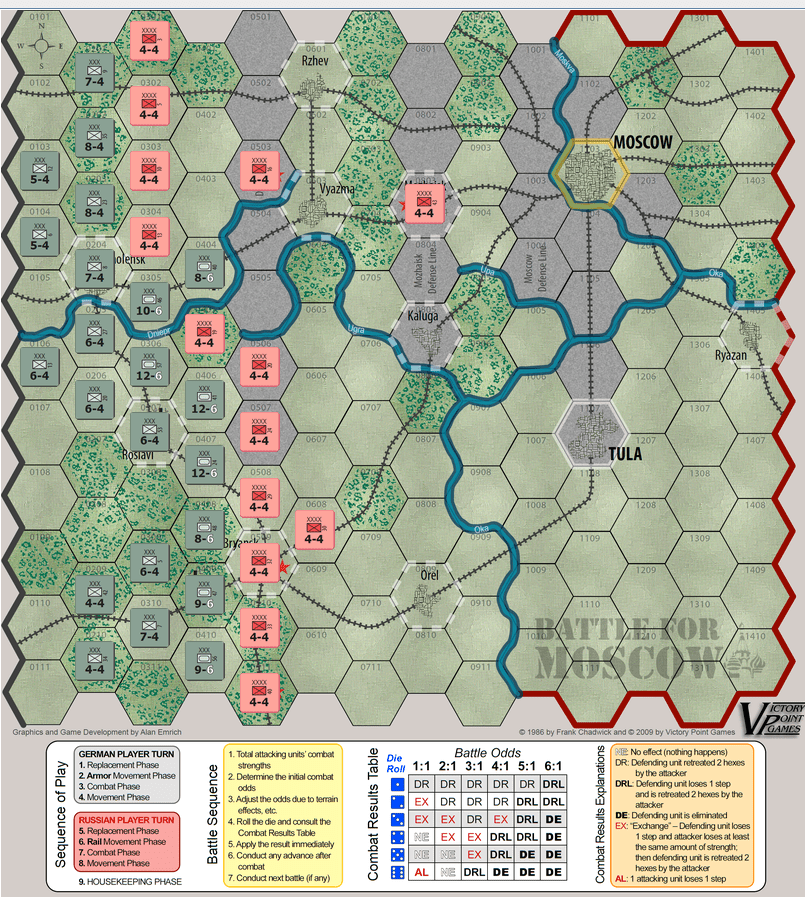
The board game is based on the battle battle which took place during the World War two. In September of 1941, the German High Command decided to launch a final, decisive offensive to crown their invasion of Russia, capture Moscow, and break the Red Army once and for all. Code named Operation Typhoon, German tanks and infantry pressed relentlessly forward until they could see the very spires of the Kremlin.
Players place their pieces on the indicated hexes of the game board. Each unit in Battle for Moscow is double sided. Both sides of the unit counter have numbers printed on them, representing the unit’s movement allocation and strength of the unit. One side shows the unit’s full strength capability, while the other displays the unit’s half-strength capability. During gameplay, a unit can be damaged, but not completely destroyed; and likewise, reinforcements can be brought in to bring a half-strength unit back to full strength.
The setup for the Russians is easy. Russian hold Moscow at the start of the game. The Russian units are placed in the indicated hexes, with the half-strength side facing up. All of the Russian units have the same statistics, so it doesn’t matter where they are placed. The German setup is little tricky. Panzer movements can be ranged movement by unit type and nearby terrain. It can be affected by transportation types. Can mix movement and combat phases.
We can add a few tweaks to make the game more interesting. Each side gets 2 point per enemy unit destroyed, even if they are replaced later. The Germans get 10 points if they can occupy Moscow at the end of any Soviet player turn. We can add the situation of frostbite. If a player unit is on a tile for more than 2 turns there are chances they get frost bite, we can use dice to decide the outcome.
Whoever holds Moscow at the end of the game wins.
 Cyrus's blog